
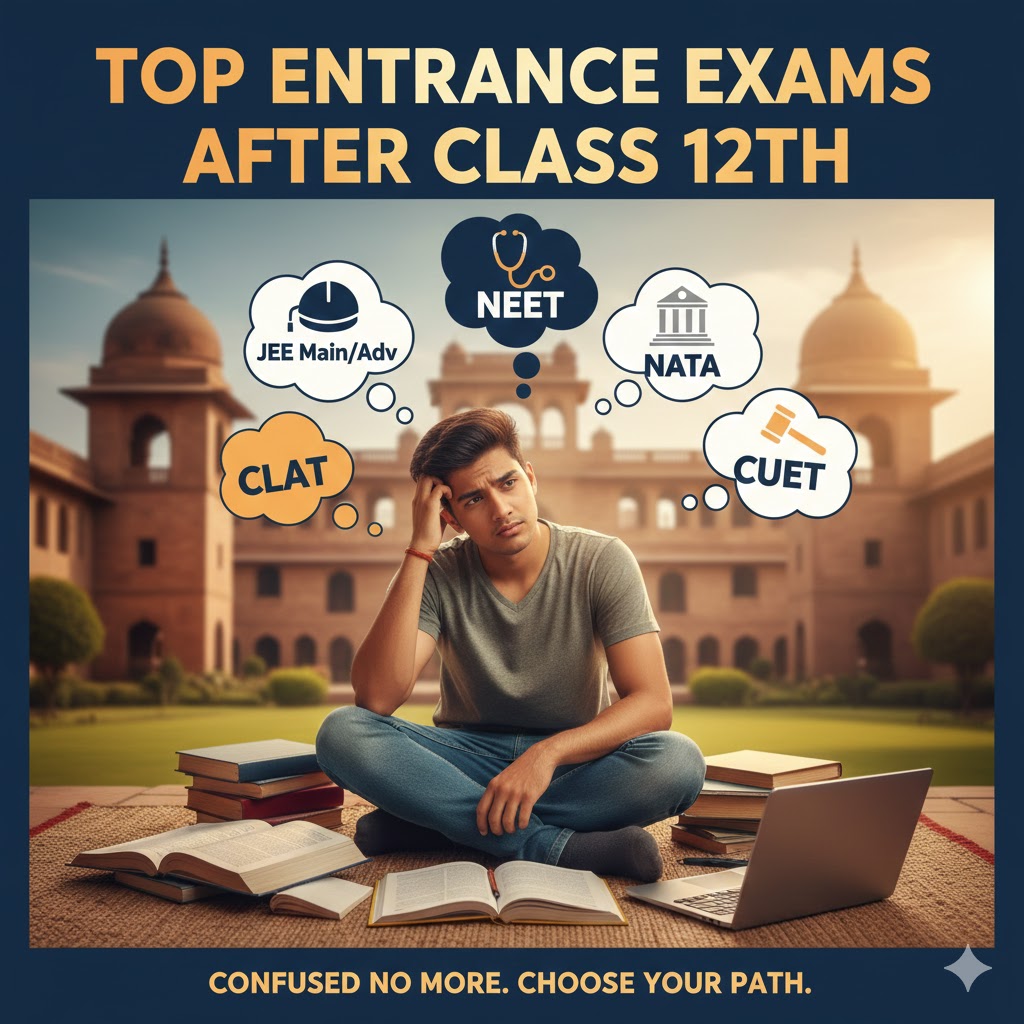
A stream-wise guide to major entrance exams after 12th – eligibility, career paths, and smart decisions for your future.
Read more: Top Entrance Exams After 12th – Stream-wise GuideA Stream-wise Guide to Major Entrance Exams After 12th: Eligibility, Career Paths, and Smart Decisions for Your Future
The journey after Class 12th is a pivotal moment for every Indian student. It’s a time of excitement, anticipation, and often, a fair bit of confusion. With a multitude of courses and entrance exams, making the right choice can feel overwhelming. This guide aims to simplify that process by offering a stream-wise breakdown of major entrance exams, their eligibility criteria, potential career paths, and how to make smart decisions for a bright future.
The Science Stream: Engineering, Medicine, and Beyond
For students who have opted for Physics, Chemistry, and Mathematics (PCM) or Physics, Chemistry, and Biology (PCB), the options are vast and competitive.
1. Engineering (PCM)
Engineering remains one of the most sought-after career paths in India. From Computer Science to Mechanical, Civil to Electronics, the demand for skilled engineers is ever-present.
- Major Entrance Exams:
- JEE Main: This is the gateway to NITs, IIITs, GFTIs, and serves as the preliminary exam for JEE Advanced.
- JEE Advanced: The ultimate test for admission to the prestigious Indian Institutes of Technology (IITs).
- BITSAT: For admissions to Birla Institute of Technology and Science (BITS) campuses in Pilani, Goa, and Hyderabad.
- VITEEE, SRMJEE, MET (Manipal), COMEDK UGET (Karnataka private colleges): Various state-level and private university entrance exams.
- CUET (Common University Entrance Test): Increasingly adopted by many central and state universities for their engineering programs.
- Eligibility: Generally, 10+2 with PCM, with a minimum percentage requirement (often 45-75% depending on the institution/exam). Age limits can apply for some exams.
- Career Paths: Software Developer, Data Scientist, Mechanical Engineer, Civil Engineer, Electrical Engineer, Robotics Engineer, Aerospace Engineer, Research & Development, Management roles, and entrepreneurship.
2. Medicine (PCB)
For those passionate about healthcare and the human body, the medical field offers rewarding careers.
- Major Entrance Exam:
- NEET (National Eligibility cum Entrance Test): The single gateway for admission to MBBS, BDS, AYUSH (BAMS, BHMS, BUMS, BSMS) courses in all medical colleges across India.
- Eligibility: 10+2 with PCB and English, with a minimum aggregate percentage (usually 50% for General category). Minimum age of 17 years by December 31st of the admission year.
- Career Paths: Doctor (various specializations), Dentist, Surgeon, Veterinarian (if opted for veterinary science), Pharmacist, Research Scientist, Public Health Specialist.
The Commerce Stream: Finance, Business, and Economics
Students with a Commerce background have a strong foundation for careers in finance, accounting, business management, and economics.
- Major Entrance Exams:
- CUET (Common University Entrance Test): Increasingly important for admission to B.Com, BBA, BA (Economics Hons.) in many central and state universities.
- IPMAT (Integrated Program in Management Aptitude Test): For admission to the 5-year Integrated Program in Management (BBA+MBA) offered by IIM Indore, IIM Rohtak, and other IIMs.
- SET (Symbiosis Entrance Test): For various undergraduate courses like BBA, BCA, BA (Mass Comm) offered by Symbiosis International (Deemed University).
- NPAT (NMIMS Programs After Twelfth): For BBA, B.Com (Hons), B.Sc. Finance at Narsee Monjee Institute of Management Studies (NMIMS).
- Christ University Entrance Test: For various undergraduate programs at Christ University.
- DU JAT (Delhi University Joint Admission Test): Previously for BBA (FIA), BMS, BA (Hons) Business Economics in Delhi University; now integrated with CUET.
- Eligibility: Generally, 10+2 in Commerce (or any stream for many BBA/BMS courses), with a minimum percentage requirement.
- Career Paths: Accountant, Financial Analyst, Investment Banker, Marketing Manager, Human Resources Manager, Business Consultant, Entrepreneur, Economist, Chartered Accountant (CA), Company Secretary (CS), Cost and Management Accountant (CMA).
The Arts/Humanities Stream: Law, Media, Design, and Social Sciences
Often misunderstood, the Arts or Humanities stream is the foundation for some of the most dynamic and high-impact careers in law, public service, media, and creative industries. The vast majority of these professional courses are open to students from any stream.
3. Law (5-Year Integrated Programs)
Law is a prestigious and intellectually challenging career open to students from Science, Commerce, and Arts streams. The integrated programs save a year compared to pursuing a 3-year degree followed by an LLB.
- Major Entrance Exams:
- CLAT (Common Law Admission Test): The premier national-level exam for admission to 24 National Law Universities (NLUs) for BA LLB, BBA LLB, etc.
- AILET (All India Law Entrance Test): Specifically for admission to the highly ranked National Law University, Delhi (NLU-D).
- SLAT (Symbiosis Law Admission Test): For Symbiosis Law Schools in Pune, Noida, Hyderabad, etc.
- LSAT—India (Law School Admission Test): Accepted by many top private law colleges across India.
- Eligibility: 10+2 from any recognized board, typically with a minimum of 45% (40% for reserved categories).
- Career Paths: Corporate Lawyer, Litigation Lawyer, Judge (Judicial Services), Legal Analyst, Public Prosecutor, Policy Advisor, Civil Services (UPSC).
4. Design & Architecture
For the creatively inclined, B.Des (Bachelor of Design) and B.Arch (Bachelor of Architecture) offer a perfect blend of art and technology.
| Field | Major Entrance Exams | Eligibility | Career Paths |
| Design (B.Des) | NIFT (National Institute of Fashion Tech), NID DAT (National Institute of Design), UCEED (for IITs/IISc). | 10+2 from any stream. | Fashion Designer, Graphic Designer, UX/UI Designer, Interior Designer, Animator. |
| Architecture (B.Arch) | NATA (National Aptitude Test in Architecture), JEE Main Paper 2 (for IITs/NITs). | 10+2 with PCM (or PCB/Commerce for some programs), usually requiring a minimum of 50% aggregate. | Architect, Urban Planner, Landscape Designer, Project Manage |
5. Journalism, Mass Communication, and Liberal Arts
These fields cater to students with strong communication, analytical, and critical thinking skills.
- Major Entrance Exams:
- CUET: For B.A. (Hons) in subjects like Political Science, History, Psychology, Economics, and for BJMC (Bachelor of Journalism and Mass Communication) in Central Universities (like DU, JNU).
- SET/NPAT/Christ Entrance Test: For BBA, Liberal Arts, Journalism, etc., in respective private universities.
- Eligibility: 10+2 from any stream.
- Career Paths: Journalist, Editor, Public Relations (PR) Specialist, Content Writer, Political Analyst, Psychologist/Counsellor (with post-graduation), NGO/Social Worker.
Other Important Career Pathways
6. Hotel Management
This stream offers a professional gateway into the global hospitality and tourism industry.
- Major Entrance Exam: NCHMCT JEE (National Council for Hotel Management and Catering Technology Joint Entrance Examination).
- Eligibility: 10+2 from any stream.
- Career Paths: Hotel Manager, Chef, Event Manager, Cruise Line Management, Tourism Development Officer.
7. Direct Entry to Government Services (Clerical & Defence)
For students seeking stability and early employment, specific government exams are available right after Class 12.
- Major Entrance Exams:
- NDA (National Defence Academy): For joining the Indian Army, Navy, and Air Force as an Officer (UPSC conducted).
- SSC CHSL (Combined Higher Secondary Level): For clerical and data entry positions in various Central Government Ministries and Departments.
- RRB NTPC (Non-Technical Popular Categories – Undergraduate Level): For various clerical and assistant posts in Indian Railways.
- Eligibility: 10+2, often with a specific age range (e.g., 16.5 to 19.5 for NDA).
- Career Paths: Commissioned Officer in Armed Forces, Lower Division Clerk (LDC), Data Entry Operator (DEO), Railway Clerk.
Smart Decisions for Your Future: A 3-Step Strategy
Choosing your path is not just about clearing an exam; it’s about making a well-informed life decision.
- Aptitude vs. Interest: Acknowledge both. You might be interested in medicine, but does your aptitude (conceptual clarity, memory, stamina) align with the rigorous NEET preparation? Similarly, you might be good at math (aptitude), but if you hate it, a career in finance might lead to burnout. Find the sweet spot between what you enjoy and what you excel at.
- Research the “End Game”: Don’t just look at the course; look at the career that follows. What does a typical day look like for a software engineer vs. a lawyer vs. an IAS officer? Use internet resources and talk to professionals in the field before committing to two years of intense exam preparation.
- The CUET Advantage: With the introduction of CUET (Common University Entrance Test), admission to many General B.A./B.Com/B.Sc. programs in Central Universities is streamlined. Use this exam to keep high-quality academic options open, especially for Arts and Commerce students, while simultaneously preparing for professional exams like JEE or NEET.
Your Class 12 marks open doors, but your entrance exam rank determines the quality of the college, which, in turn, heavily influences your career launchpad. Choose wisely, prepare diligently, and trust your unique journey.